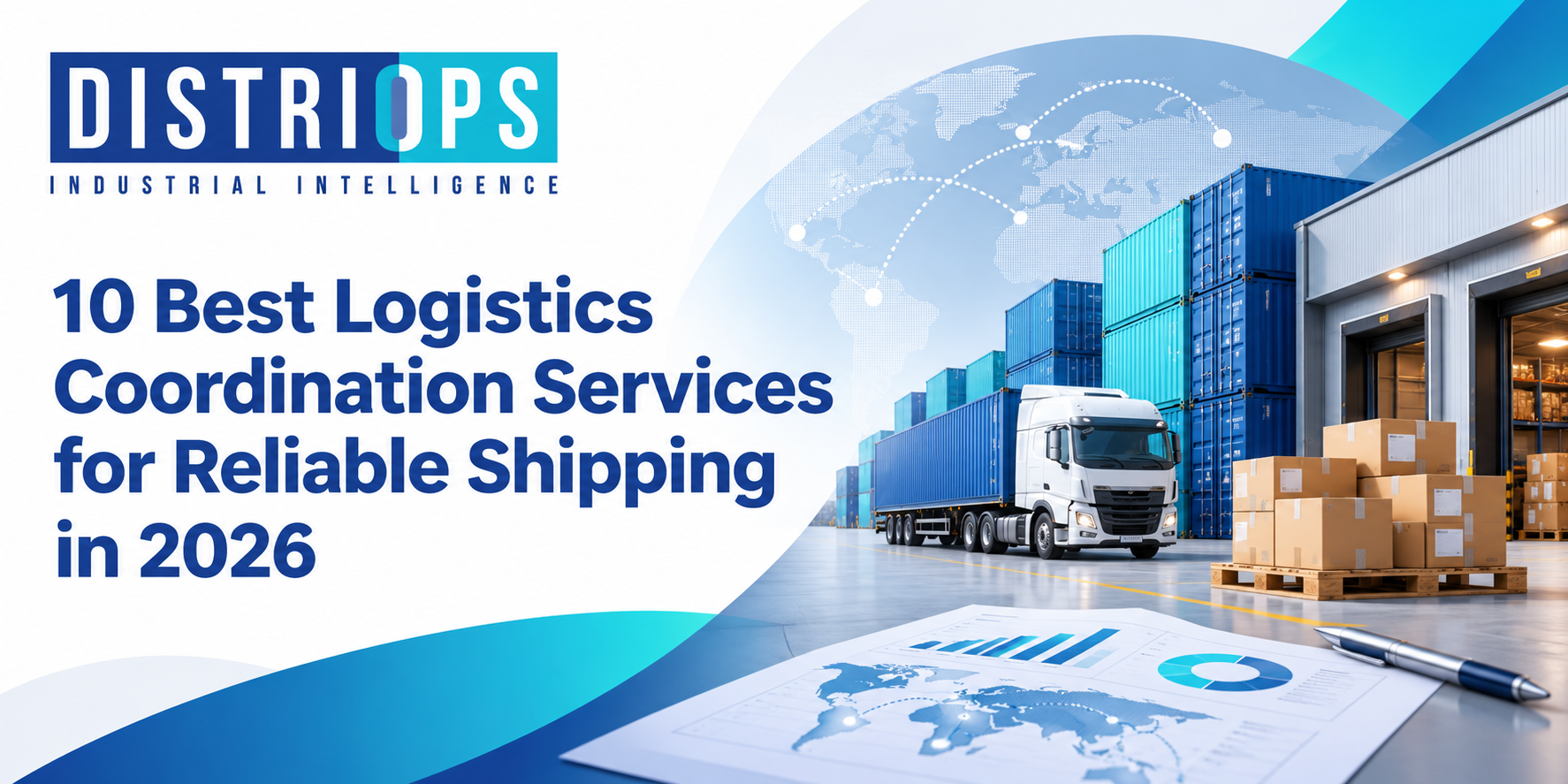
Partnering with an enterprise coordinator streamlines cross-border fulfillment, reduces demurrage costs, and ensures operational alignment across every node of your freight network.
10 Best Logistics Coordination Services for Reliable Shipping in 2026

Distriops
ON THIS PAGE
Free Match
Find an RFQ partner for your category
Tell us your product lines and current turnaround time. We’ll match you with vetted partners built for your exact vertical.
2,500+
Vetted partners
27
Verticals
Managing logistics across multiple carriers, warehouses, suppliers, and transportation networks requires more than arranging shipments. Businesses need coordinated operations that keep freight moving, maintain shipment visibility, control transportation costs, and prevent delays across the supply chain.
Logistics coordination services help businesses manage these interconnected activities through centralized shipment scheduling, carrier management, freight forwarding, warehouse coordination, and exception handling. The right logistics coordination partner brings together the people, systems, and processes needed to improve delivery reliability and maintain operational efficiency across domestic and international networks.
In this guide, we compare 10 leading logistics coordination providers in 2026, examining their core services, transportation capabilities, technology platforms, and industry expertise to help businesses identify the right partner for their supply chain requirements.
Best Logistics Coordination Services at a Glance
Selecting a dedicated logistics coordination partner requires evaluating network reach, carrier management depth, and software integration capabilities. The comparison table below highlights top-tier providers across core operational parameters to support strategic partner selection.
| Provider | Best For | Core Services | Modes | Visibility | Geographic Coverage | Ideal For |
|---|---|---|---|---|---|---|
| DHL Supply Chain | Global multi-modal coordination | Control tower management, contract warehousing, lead logistics | Air, Ocean, Road, Rail | Real-time predictive telemetry | Global (220+ countries & territories) | Enterprise brand owners & high-volume shippers |
| Kuehne + Nagel | International ocean & air orchestration | Customs brokerage, carrier allocation, inventory positioning | Ocean, Air, Road | SeaExplorer predictive tracking | Global (100+ countries) | High-volume cross-border import/export operations |
| DSV | Non-asset supply chain optimization | 4PL coordination, freight consolidation, customs clearance | Air, Ocean, Road, Rail | myDSV unified portal | Global (80+ countries) | Mid-market to enterprise global supply networks |
| DB Schenker | European land & global multi-modal | Intermodal routing, hub orchestration, cross-dock management | Road, Rail, Air, Ocean | Connect 4.0 tracking engine | Global (130+ countries) | Industrial manufacturers & heavy supply networks |
| C.H. Robinson | Asset-light surface transport optimization | Managed TMS, freight matching, carrier compliance, spot routing | Truckload, LTL, Ocean, Air | Navisphere real-time tracking | Global (Americas focus) | High-frequency surface freight & retail suppliers |
| CEVA Logistics | Inbound-to-manufacturing coordination | Line-feed management, reverse logistics, raw materials staging | Air, Ocean, Road | Matrix supply chain platform | Global (170+ countries) | Automotive, aerospace, & complex manufacturing |
| Expeditors | High-compliance air & ocean forwarding | Order-level tracking, duty drawdowns, origin consolidation | Air, Ocean, Road | Enterprise visibility suite | Global (60+ countries) | High-value tech, pharma, & retail importers |
| Geodis | Turnkey contract logistics & distribution | Fulfillment center management, omnichannel orchestration | Road, Air, Ocean, Rail | GeoFlow visibility engine | Global (120+ countries) | Omnichannel retail & international consumer brands |
| Kenco Logistics | North American warehousing & transport | Distributed fulfillment, dedicated fleet management, network design | Truckload, LTL, Dedicated | Kenco Innovation Lab portal | North America | US-centric brands needing deep warehousing integration |
| Schneider Logistics | Dedicated fleet & intermodal orchestration | Power-only capacity, intermodal routing, 3PL/4PL coordination | Intermodal, Dedicated, LTL | FreightPower tracking platform | North America | Shippers needing high-capacity surface transport |
83%
of shippers rely on outsourcing to achieve operational service improvements and streamline complex B2B supply chains. – Infosys Supply Chain Report
95%
of enterprise shippers rate their working relationships with logistics partners as successful and operationally essential. – Penske Logistics Study
86%
of shippers confirm that utilizing specialized logistics service providers has contributed directly to elevated customer service levels. – PLS Logistics
What Is a Logistics Coordination Service?
A logistics coordination service serves as the operational orchestration hub that connects shippers, ocean lines, motor carriers, air freight operators, and distribution centers into a unified supply chain workflow. Unlike basic freight brokers that handle transactional spot moves, dedicated supplier coordination services manage structural logistics workflows, carrier scorecards, regulatory compliance, and inventory handoffs.
Orchestrating complex freight movements requires active oversight across administrative, technical, and physical operational layers.
Understanding the structural distinctions between service models prevents misaligned software procurement and operational friction.
A transport management system (TMS) is a software platform that provides automation tools but requires internal staff to execute operations. A standard Third-Party Logistics (3PL) provider offers physical asset execution—such as running a specific warehouse or truck fleet—focused on discrete execution tasks.
In contrast, full-scope logistics optimization services integrate advanced software with operational expertise, actively managing multiple 3PLs, carriers, and facility hubs to optimize cost, velocity, and compliance across your entire ecosystem.
What Logistics Coordinators Typically Manage
Orchestrating complex freight movements requires active oversight across administrative, technical, and physical operational layers.
- Carrier Allocation and Booking: Managing tender sequences, contract adherence, and spot market backup routing across preferred carrier lists.
- Shipment Scheduling and Consolidation: Combining Less-Than-Truckload (LTL) shipments into Full-Truckload (FTL) orders and scheduling appointment windows.
- End-to-End Tracking: Monitoring milestone updates, tracking GPS location fixes, and updating predicted times of arrival (PTA).
- Documentation and Compliance: Processing bills of lading (BOL), commercial invoices, customs entries, and origin certificates.
- Exception Handling: Managing port delays, weather detours, equipment shortages, and claim filings in real time.
Logistics Coordination Service vs. 3PL vs. TMS Software
Understanding the structural distinctions between service models prevents misaligned software procurement and operational friction.
A transport management system (TMS) is a software platform that provides automation tools but requires internal staff to execute operations. A standard Third-Party Logistics (3PL) provider offers physical asset execution—such as running a specific warehouse or truck fleet—focused on discrete execution tasks.
In contrast, full-scope logistics optimization services integrate advanced software with operational expertise, actively managing multiple 3PLs, carriers, and facility hubs to optimize cost, velocity, and compliance across your entire ecosystem.
Choosing the right logistics coordination partner strengthens communication, improves visibility, and creates adaptable governance across every tier of your distribution network. Standardizing transport workflows and enforcing carrier accountability protects profit margins while maintaining consistent customer delivery commitments.
Vice President of Global Logistics, Enterprise Supply Chain Alliance
Top Logistics Coordination Services
Selecting the right partner requires analyzing operational capabilities, geographical network footprints, and specialized industry expertise.
DHL Supply Chain operates as a premier lead logistics partner (LLP) and control tower operator, coordinating complex global supply networks. Their teams manage integrated contract warehousing, air and ocean freight forwarding, and domestic road transport through centralized digital platforms. Utilizing predictive data models, DHL optimizes carrier allocations, mitigates port bottleneck risks, and provides end-to-end shipment visibility.
The organization specializes in supporting enterprise retail, technology, automotive, and healthcare sectors. By combining owned logistics assets with third-party carrier management, DHL delivers scalable control tower workflows. The main operational constraint for mid-market shippers is that DHL’s service architecture is tailored primarily for high-volume enterprise supply chains.
Kuehne + Nagel excels in international air and sea freight orchestration, providing end-to-end import and export coordination. Their digital platform, Seaexplorer, provides real-time vessel tracking, carbon monitoring, and predictive routing to minimize supply chain disruptions. Their team manages complex customs clearance procedures, origin consolidation programs, and drayage routing across major global trade lanes.
The company is an ideal fit for enterprise importers and exporters operating across complex international regulatory environments. Their deep carrier relationships secure allocation stability even during peak capacity seasons. However, shippers seeking domestic truckload or parcel-only coordination may find Kuehne + Nagel’s service portfolio less focused on domestic surface transport.
DSV provides non-asset and asset-light 4PL supply chain solutions, specializing in global freight forwarding, road transport networks, and contract logistics. Their coordination teams handle multi-modal transport planning, customs brokerage, and hub distribution through unified client interfaces like myDSV. DSV’s operational agility allows them to structure customized logistics workflows for industrial, consumer product, and healthcare organizations.
Their primary strength lies in freight consolidation, non-asset carrier negotiation, and flexible routing architectures. By leveraging extensive carrier networks without being bound to rigid fleet assets, DSV adapts rapidly to shifting lane conditions. A potential trade-off is that service consistency can vary across regions acquired through rapid organizational acquisitions.
DB Schenker delivers extensive European land transport capabilities integrated with global air and ocean freight forwarding. Their coordination specialists manage rail, road intermodal, cross-docking, and industrial inventory logistics across major manufacturing hubs. Utilizing their Connect 4.0 portal, clients gain real-time pricing transparency, instant booking capabilities, and milestone tracking across global corridors.
DB Schenker excels in managing heavy manufacturing, automotive, and industrial goods supply chains. Their vast European rail and trucking network offers unmatched ground transport density. However, shippers operating primarily outside major European or Transpacific industrial lanes may experience less dense ground infrastructure coverage.
C.H. Robinson is a leading asset-light freight coordination provider, operating one of the largest surface transportation networks in North America. Powered by their Navisphere platform, they coordinate truckload, LTL, temperature-controlled, and ocean freight movements for thousands of global shippers. Their specialized freight forwarding logistics coordination service utilizes machine learning algorithms to optimize carrier matching, spot pricing, and routing efficiency.
Their core strength lies in surface transport capacity access, spot-market responsiveness, and managed TMS services. They serve retail, food and beverage, and industrial sectors effectively. Shippers looking for heavily asset-owned international contract warehousing may need to combine C.H. Robinson’s transport coordination with specialized regional warehouse operators.
CEVA Logistics provides specialized inbound-to-manufacturing coordination and contract logistics services. Their teams manage raw materials staging, sub-assembly line feeding, kitting, and reverse logistics across global production facilities. Through their proprietary Matrix platform, CEVA coordinates complex multi-tiered supplier bases to guarantee timely factory deliveries.
CEVA is tailored for industrial, automotive, aerospace, and high-tech manufacturing supply chains. Their focus on lean manufacturing integration protects production schedules from stockouts. However, fast-moving consumer goods (FMCG) brands requiring simple, low-cost parcel fulfillment may find CEVA’s industrial processes unnecessarily complex.
Expeditors provides non-asset freight forwarding and supply chain management, built on uniform technology infrastructure across all global branch offices. They coordinate air, ocean, and ground freight movements while managing complex customs compliance, duty drawdowns, and origin cargo management. Their custom software platform provides granular, order-level tracking from initial purchase order issuance through final delivery.
Expeditors excels in high-value, time-sensitive industries, including electronics, pharmaceuticals, and retail apparel. Their single-platform architecture guarantees consistent data tracking and operational compliance worldwide. Because they focus strictly on organic growth rather than acquisitions, their physical warehouse footprint is more selective than that of mega-3PL contract logistics providers.
Geodis offers turnkey contract logistics, freight forwarding, and end-to-end distribution coordination across international markets. Their operational capabilities cover multi-modal transport planning, customs clearance, e-commerce fulfillment, and final-mile delivery. Utilizing their GeoFlow platform, Geodis integrates physical warehouse operations with dynamic transport routing to maintain visibility across complex fulfillment networks.
Geodis is well-suited for omnichannel retail, luxury goods, and consumer electronics brands needing balanced warehouse and transport coordination. Their flexible distribution models support seasonal volume spikes cleanly. Shippers operating exclusively within niche regional markets may find enterprise-scale contract terms less economical.
Kenco Logistics delivers specialized North American contract warehousing, dedicated fleet transport, and material handling management. They operate millions of square feet of distribution space, managing specialized warehouse coordination services alongside intermodal and LTL freight optimization. Through the Kenco Innovation Lab, they deploy automated picking technologies, advanced WMS connectors, and real-time inventory tracking.
Kenco is ideal for middle-market and enterprise brands seeking deep North American warehouse integration paired with ground transport routing. Their customer-centric management style yields high contract retention rates. However, organizations requiring international air and ocean freight forwarding must partner with external global forwarders.
Schneider Logistics combines dedicated truckload fleets, intermodal rail transport, and third-party logistics management across North America. Their logistics division manages carrier tendering, freight payment auditing, and supply chain network redesign via their FreightPower digital platform. Schneider’s power-only capacity models allow shippers to scale transport capacity rapidly during peak volume cycles.
Schneider is a strong operational fit for high-volume retail suppliers, paper products, and industrial shippers requiring consistent North American surface transport. Their intermodal rail connections provide cost-effective long-haul transit. Shippers requiring global ocean forwarding or overseas customs brokerage will need to supplement Schneider’s regional strengths with international specialists.
1. DHL Supply Chain
DHL Supply Chain operates as a premier lead logistics partner (LLP) and control tower operator, coordinating complex global supply networks. Their teams manage integrated contract warehousing, air and ocean freight forwarding, and domestic road transport through centralized digital platforms. Utilizing predictive data models, DHL optimizes carrier allocations, mitigates port bottleneck risks, and provides end-to-end shipment visibility.
The organization specializes in supporting enterprise retail, technology, automotive, and healthcare sectors. By combining owned logistics assets with third-party carrier management, DHL delivers scalable control tower workflows. The main operational constraint for mid-market shippers is that DHL’s service architecture is tailored primarily for high-volume enterprise supply chains.
2. Kuehne + Nagel
Kuehne + Nagel excels in international air and sea freight orchestration, providing end-to-end import and export coordination. Their digital platform, Seaexplorer, provides real-time vessel tracking, carbon monitoring, and predictive routing to minimize supply chain disruptions. Their team manages complex customs clearance procedures, origin consolidation programs, and drayage routing across major global trade lanes.
The company is an ideal fit for enterprise importers and exporters operating across complex international regulatory environments. Their deep carrier relationships secure allocation stability even during peak capacity seasons. However, shippers seeking domestic truckload or parcel-only coordination may find Kuehne + Nagel’s service portfolio less focused on domestic surface transport.
3. DSV
DSV provides non-asset and asset-light 4PL supply chain solutions, specializing in global freight forwarding, road transport networks, and contract logistics. Their coordination teams handle multi-modal transport planning, customs brokerage, and hub distribution through unified client interfaces like myDSV. DSV’s operational agility allows them to structure customized logistics workflows for industrial, consumer product, and healthcare organizations.
Their primary strength lies in freight consolidation, non-asset carrier negotiation, and flexible routing architectures. By leveraging extensive carrier networks without being bound to rigid fleet assets, DSV adapts rapidly to shifting lane conditions. A potential trade-off is that service consistency can vary across regions acquired through rapid organizational acquisitions.
4. DB Schenker
DB Schenker delivers extensive European land transport capabilities integrated with global air and ocean freight forwarding. Their coordination specialists manage rail, road intermodal, cross-docking, and industrial inventory logistics across major manufacturing hubs. Utilizing their Connect 4.0 portal, clients gain real-time pricing transparency, instant booking capabilities, and milestone tracking across global corridors.
DB Schenker excels in managing heavy manufacturing, automotive, and industrial goods supply chains. Their vast European rail and trucking network offers unmatched ground transport density. However, shippers operating primarily outside major European or Transpacific industrial lanes may experience less dense ground infrastructure coverage.
5. C.H. Robinson
C.H. Robinson is a leading asset-light freight coordination provider, operating one of the largest surface transportation networks in North America. Powered by their Navisphere platform, they coordinate truckload, LTL, temperature-controlled, and ocean freight movements for thousands of global shippers. Their specialized freight forwarding logistics coordination service utilizes machine learning algorithms to optimize carrier matching, spot pricing, and routing efficiency.
Their core strength lies in surface transport capacity access, spot-market responsiveness, and managed TMS services. They serve retail, food and beverage, and industrial sectors effectively. Shippers looking for heavily asset-owned international contract warehousing may need to combine C.H. Robinson’s transport coordination with specialized regional warehouse operators.
6. CEVA Logistics
CEVA Logistics provides specialized inbound-to-manufacturing coordination and contract logistics services. Their teams manage raw materials staging, sub-assembly line feeding, kitting, and reverse logistics across global production facilities. Through their proprietary Matrix platform, CEVA coordinates complex multi-tiered supplier bases to guarantee timely factory deliveries.
CEVA is tailored for industrial, automotive, aerospace, and high-tech manufacturing supply chains. Their focus on lean manufacturing integration protects production schedules from stockouts. However, fast-moving consumer goods (FMCG) brands requiring simple, low-cost parcel fulfillment may find CEVA’s industrial processes unnecessarily complex.
7. Expeditors
Expeditors provides non-asset freight forwarding and supply chain management, built on uniform technology infrastructure across all global branch offices. They coordinate air, ocean, and ground freight movements while managing complex customs compliance, duty drawdowns, and origin cargo management. Their custom software platform provides granular, order-level tracking from initial purchase order issuance through final delivery.
Expeditors excels in high-value, time-sensitive industries, including electronics, pharmaceuticals, and retail apparel. Their single-platform architecture guarantees consistent data tracking and operational compliance worldwide. Because they focus strictly on organic growth rather than acquisitions, their physical warehouse footprint is more selective than that of mega-3PL contract logistics providers.
8. Geodis
Geodis offers turnkey contract logistics, freight forwarding, and end-to-end distribution coordination across international markets. Their operational capabilities cover multi-modal transport planning, customs clearance, e-commerce fulfillment, and final-mile delivery. Utilizing their GeoFlow platform, Geodis integrates physical warehouse operations with dynamic transport routing to maintain visibility across complex fulfillment networks.
Geodis is well-suited for omnichannel retail, luxury goods, and consumer electronics brands needing balanced warehouse and transport coordination. Their flexible distribution models support seasonal volume spikes cleanly. Shippers operating exclusively within niche regional markets may find enterprise-scale contract terms less economical.
9. Kenco Logistics
Kenco Logistics delivers specialized North American contract warehousing, dedicated fleet transport, and material handling management. They operate millions of square feet of distribution space, managing specialized warehouse coordination services alongside intermodal and LTL freight optimization. Through the Kenco Innovation Lab, they deploy automated picking technologies, advanced WMS connectors, and real-time inventory tracking.
Kenco is ideal for middle-market and enterprise brands seeking deep North American warehouse integration paired with ground transport routing. Their customer-centric management style yields high contract retention rates. However, organizations requiring international air and ocean freight forwarding must partner with external global forwarders.
10. Schneider Logistics
Schneider Logistics combines dedicated truckload fleets, intermodal rail transport, and third-party logistics management across North America. Their logistics division manages carrier tendering, freight payment auditing, and supply chain network redesign via their FreightPower digital platform. Schneider’s power-only capacity models allow shippers to scale transport capacity rapidly during peak volume cycles.
Schneider is a strong operational fit for high-volume retail suppliers, paper products, and industrial shippers requiring consistent North American surface transport. Their intermodal rail connections provide cost-effective long-haul transit. Shippers requiring global ocean forwarding or overseas customs brokerage will need to supplement Schneider’s regional strengths with international specialists.
Elevate Your Global Supply Chain Network
Evaluating freight forwarders, 4PL control towers, and contract logistics specialists requires comparing network reach, technology stacks, and operational SLAs. Utilize our provider evaluation framework to identify the right partner for your enterprise.
How to Choose the Best Logistics Coordination Service
Selecting an optimal logistics partner requires evaluating operational execution capabilities against your organization’s unique supply chain profile. Using a structured decision framework ensures your chosen coordinator aligns with your service SLAs, IT infrastructure, and growth trajectory.
Verify that potential partners operate established carrier lanes and facility hubs within your primary sourcing and distribution regions. Evaluating whether a provider specializes in global cross-border trade or regional surface distribution prevents operational gaps.
Assess the depth of a provider’s contracted carrier base, asset ownership, and spot-market capacity access. A strong partner leverages preferred carrier relationships to secure capacity, control freight rates, and ensure pickup reliability during market disruptions.
Review the partner’s digital visibility platforms to confirm they provide real-time GPS tracking, automated milestone alerts, and predictive ETA metrics. Ensuring their control tower software provides order-level visibility allows internal customer service teams to address transit exceptions proactively.
Select a coordinator capable of managing air, ocean, rail, truckload, and LTL transport modes seamlessly within a single operational workflow. Comprehensive multi-modal coordination enables dynamic route optimization when ocean or air channels experience unexpected cost spikes or capacity constraints.
Examine the provider’s operational support structure, dedicated account team availability, and exception escalation protocols. Establishing clear service level agreements (SLAs) for resolving delayed shipments, transit damages, and customs holds guarantees fast operational recovery.
Ensure the coordinator’s transport and warehouse systems integrate cleanly with your internal ERP, WMS, and order management platforms via modern APIs or standardized EDI protocols. Automated data flows eliminate manual spreadsheet updates, reduce processing errors, and accelerate billing cycles.
Partner with a provider that demonstrates proven expertise within your specific vertical market, such as cold-chain pharma, hazardous materials, or high-velocity retail. Specialized industry knowledge guarantees compliance with sector-specific storage rules, packaging standards, and regulatory reporting mandates.
Analyze total cost structures, including gain-share arrangements, management fees, transactional markup rates, and accessorial charge schedules. Transparent fee structures align the coordinator’s incentives directly with your supply chain cost-reduction targets.
Evaluate Transportation and Geographic Coverage
Verify that potential partners operate established carrier lanes and facility hubs within your primary sourcing and distribution regions. Evaluating whether a provider specializes in global cross-border trade or regional surface distribution prevents operational gaps.
Check Carrier-Network Strength
Assess the depth of a provider’s contracted carrier base, asset ownership, and spot-market capacity access. A strong partner leverages preferred carrier relationships to secure capacity, control freight rates, and ensure pickup reliability during market disruptions.
Compare Tracking and Visibility Capabilities
Review the partner’s digital visibility platforms to confirm they provide real-time GPS tracking, automated milestone alerts, and predictive ETA metrics. Ensuring their control tower software provides order-level visibility allows internal customer service teams to address transit exceptions proactively.
Assess Multimodal Support
Select a coordinator capable of managing air, ocean, rail, truckload, and LTL transport modes seamlessly within a single operational workflow. Comprehensive multi-modal coordination enables dynamic route optimization when ocean or air channels experience unexpected cost spikes or capacity constraints.
Review Response and Escalation Processes
Examine the provider’s operational support structure, dedicated account team availability, and exception escalation protocols. Establishing clear service level agreements (SLAs) for resolving delayed shipments, transit damages, and customs holds guarantees fast operational recovery.
Check Technology and Integrations
Ensure the coordinator’s transport and warehouse systems integrate cleanly with your internal ERP, WMS, and order management platforms via modern APIs or standardized EDI protocols. Automated data flows eliminate manual spreadsheet updates, reduce processing errors, and accelerate billing cycles.
Evaluate Industry Experience
Partner with a provider that demonstrates proven expertise within your specific vertical market, such as cold-chain pharma, hazardous materials, or high-velocity retail. Specialized industry knowledge guarantees compliance with sector-specific storage rules, packaging standards, and regulatory reporting mandates.
Compare Pricing Structure and Contract Terms
Analyze total cost structures, including gain-share arrangements, management fees, transactional markup rates, and accessorial charge schedules. Transparent fee structures align the coordinator’s incentives directly with your supply chain cost-reduction targets.
Conclusion
Partnering with professional logistics coordination services turns fragmented freight management into a streamlined operational advantage. Standardizing freight workflows, enforcing carrier accountability, and deploying advanced visibility platforms enables commercial enterprises to lower transit costs, eliminate delivery delays, and scale global supply networks efficiently.
Selecting the right partner requires evaluating carrier network strength, multi-modal capabilities, and technology integration standards. Investing in a modern, software-enabled warehousing services and transport coordination partner provides the operational agility required to navigate market volatility and support long-term revenue growth.
Sources & References
- Infosys: Supply Chain Management & Logistics Outsourcing Services. – 2026
- Penske Logistics: Third-Party Logistics (3PL) Research & Industry Trends. – 2026
- PLS Logistics: Outsourcing Logistics: Benefits & Service Level Benchmarks. – 2026
Providers You Might Be Interested In
Vetted partners matched to the topics covered in this article.
QF
Verified
QuoteFlow Solutions
RFQ & Pricing Support
Dedicated quoting teams for electrical, MRO, and industrial automation distributors.
★
4.9 (128 reviews)
12 yrs in business
AR
Verified
Apex RFQ Partners
RQuote Management BPO
24-hour SLA-backed quote turnaround with full CPQ and ERP integration support.
★
4.8 (94 reviews)
8 yrs in business
PL
Verified
PriceLogic Outsourcing
Pricing & Order Support
Specialists in contract pricing accuracy and tiered-discount management for distributors.
★
4.7 (78 reviews)
15 yrs in business



About DistriOps
Built for Industrial Operations & Execution
DistriOps is designed to help industrial distributors, manufacturers, and operations-heavy businesses connect with trusted operational partners faster.
What DistriOps Helps Businesses Do
- Find verified outsourcing and operational service providers
- Simplify partner discovery across industrial operations
- Reduce operational bottlenecks and manual workload
- Scale procurement, supply chain, and back-office support faster
- Access specialized execution support teams
- Improve operational efficiency across workflows
- Support high-volume operational environments
- Connect with partners experienced in industrial distribution and manufacturing
- Streamline vendor evaluation and operational collaboration
- Discover operational expertise across multiple business functions
Why DistriOps?
 Built specifically for industrial distribution & manufacturing Access to 2,500+ operational partners Focused on execution-heavy business operations Trusted network of vetted service providers Supports procurement, product data, customer support, finance & supply chain operations Faster partner discovery & operational scaling Designed for modern industrial workflow challenges