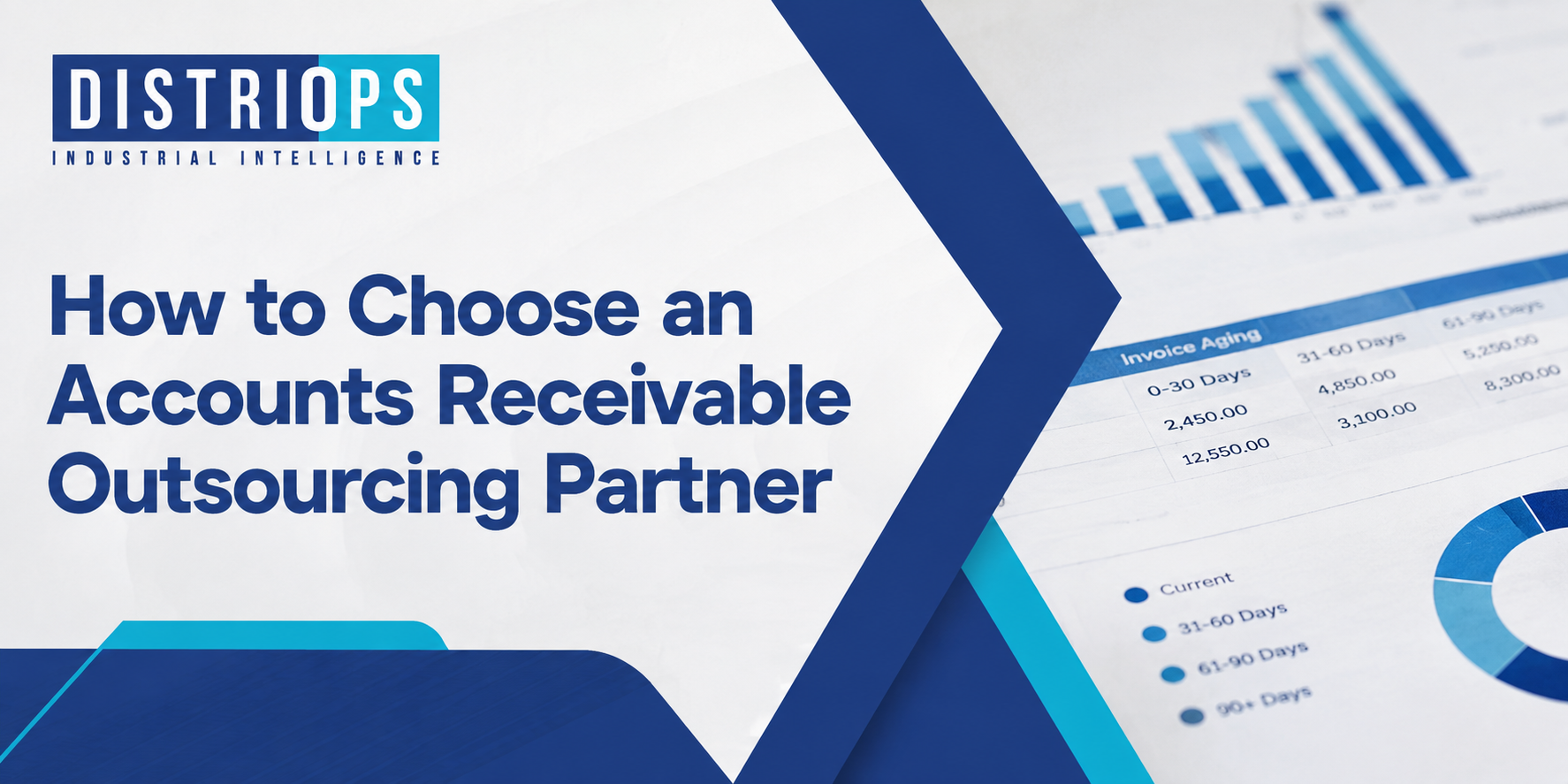
Choosing an accounts receivable outsourcing partner requires more than comparing prices. Evaluate expertise, processes, technology, KPIs, security, scalability, and long-term commercial value.
How to Choose an Accounts Receivable Outsourcing Partner

Distriops
ON THIS PAGE
Free Match
Find an RFQ partner for your category
Tell us your product lines and current turnaround time. We’ll match you with vetted partners built for your exact vertical.
2,500+
Vetted partners
27
Verticals
Choosing an accounts receivable outsourcing partner is ultimately a business decision, not simply a cost-reduction exercise. The lowest-cost provider is not necessarily the lowest-cost option once collection performance, transition effort, integration, management overhead, customer relationships, and switching costs are considered.
A strong partner should improve the way receivables move from invoice to cash while giving your finance team better visibility and control. Before reviewing providers, establish your current AR baseline and define the outcomes you expect the partner to own. This makes it easier to compare providers objectively and identify whether their capabilities match your operational requirements. Businesses can also review specialized accounts receivable collections services when assessing the scope of external support.
A strong partner should improve the way receivables move from invoice to cash while giving your finance team better visibility and control. Before reviewing providers, establish your current AR baseline and define the outcomes you expect the partner to own. This makes it easier to compare providers objectively and identify whether their capabilities match your operational requirements. Businesses can also review specialized accounts receivable collections services when assessing the scope of external support.
Start With the AR Outcomes You Need the Partner to Own
Before comparing providers, establish your current AR baseline. This gives you a measurable starting point and prevents vendors from defining success using metrics that may not matter to your business.
Your baseline should cover key AR performance and operational factors, including current DSO, aging profile, collection volume, dispute volume, AR team workload, cash application requirements, and reporting requirements. Together, these metrics provide a clear picture of your existing processes, workload, performance gaps, and areas where an outsourcing partner can deliver measurable improvement.
You should also identify where the biggest operational gaps exist. For example, a company struggling with overdue invoices may prioritize collections expertise, while another business may need stronger cash application, reconciliation, dispute management, or reporting capabilities.
Your baseline should cover key AR performance and operational factors, including current DSO, aging profile, collection volume, dispute volume, AR team workload, cash application requirements, and reporting requirements. Together, these metrics provide a clear picture of your existing processes, workload, performance gaps, and areas where an outsourcing partner can deliver measurable improvement.
You should also identify where the biggest operational gaps exist. For example, a company struggling with overdue invoices may prioritize collections expertise, while another business may need stronger cash application, reconciliation, dispute management, or reporting capabilities.
42%
of invoices are paid late, highlighting the need for dedicated accounts receivable services. – Atradius
92%
is the touchless payment rate achieved by Billtrust clients, highlighting the impact of automated accounts receivable processes.- Billtrust
15
segments of 203 industry segments reported that 10% or more of their accounts receivable aging dollars were 91+ days past due in Q2 2025.- Dun & Bradstreet
A Buyer's Framework for Evaluating AR Outsourcing Providers
Choosing the right AR outsourcing provider requires a structured evaluation across capabilities, technology, performance, security, and scalability. This framework helps buyers compare providers consistently and identify the partner best suited to their business needs.
A provider’s experience should closely match your operating environment. Look for experience with similar customer types, payment terms, transaction volumes, dispute patterns, and regulatory requirements. Industry familiarity can reduce the learning curve and help collection teams communicate appropriately with customers.
A provider that understands your industry’s payment behavior should be able to identify common causes of delayed payments and explain how its team handles them.
Evaluate the provider’s collection cadence, escalation rules, dispute workflows, exception handling, and reconciliation process. Ask how accounts are prioritized, when human intervention occurs, and how unresolved issues are escalated.
The goal is to determine whether the provider has a repeatable operating model that can deliver consistent results across different account volumes and customer segments.
Technology should support the process. Evaluate how effectively the provider integrates with your ERP, CRM, billing platforms, payment systems, and reporting environment. The important question is not how many tools the provider uses. It is how much manual intervention those tools eliminate.
Ask about automated payment matching, collection reminders, account prioritization, reporting, workflow management, exception routing, and data synchronization. For businesses managing adjacent revenue operations, reviewing returns management services can also help identify whether the provider has experience managing connected order-to-cash processes.
A provider should be accountable for measurable outcomes. Require reporting around DSO, collection rate, aging, disputes, cash application, and SLA performance. Establish KPIs that connect activity to financial outcomes. Your agreement should define reporting frequency, performance thresholds, escalation procedures, and ownership of corrective actions.
AR operations involve sensitive customer, financial, and payment information. Assess the provider’s certifications, access controls, data protection practices, audit procedures, business continuity measures, and incident-response processes. Ask where data is stored and processed, who can access it, and how access is reviewed.
Security should be evaluated before implementation rather than treated as a contractual formality after the commercial decision has already been made.
Your provider should be able to accommodate changes in transaction volume. Ask how capacity changes with volume, whether the team is dedicated or pooled, what happens during peak periods, and how quickly additional resources can be added.
Understand where the team operates, who manages day-to-day delivery, how quality is monitored, and how knowledge is retained when team members change.
Compare the commercial model alongside expected business outcomes. Common structures include fixed-fee, per-transaction, performance-based, and hybrid pricing.
Then examine minimum commitments, price escalation provisions, contract length, exit clauses, transition-out fees, and additional charges. Check if the contract includes restrictive minimum volumes, implementation fees, integration costs, or costly exit provisions. Evaluate total cost of ownership rather than the quoted service fee alone.
AR and Industry Expertise
A provider’s experience should closely match your operating environment. Look for experience with similar customer types, payment terms, transaction volumes, dispute patterns, and regulatory requirements. Industry familiarity can reduce the learning curve and help collection teams communicate appropriately with customers.
A provider that understands your industry’s payment behavior should be able to identify common causes of delayed payments and explain how its team handles them.
Process Maturity
Evaluate the provider’s collection cadence, escalation rules, dispute workflows, exception handling, and reconciliation process. Ask how accounts are prioritized, when human intervention occurs, and how unresolved issues are escalated.
The goal is to determine whether the provider has a repeatable operating model that can deliver consistent results across different account volumes and customer segments.
Technology and Integration
Technology should support the process. Evaluate how effectively the provider integrates with your ERP, CRM, billing platforms, payment systems, and reporting environment. The important question is not how many tools the provider uses. It is how much manual intervention those tools eliminate.
Ask about automated payment matching, collection reminders, account prioritization, reporting, workflow management, exception routing, and data synchronization. For businesses managing adjacent revenue operations, reviewing returns management services can also help identify whether the provider has experience managing connected order-to-cash processes.
Performance and Reporting
A provider should be accountable for measurable outcomes. Require reporting around DSO, collection rate, aging, disputes, cash application, and SLA performance. Establish KPIs that connect activity to financial outcomes. Your agreement should define reporting frequency, performance thresholds, escalation procedures, and ownership of corrective actions.
Security and Compliance
AR operations involve sensitive customer, financial, and payment information. Assess the provider’s certifications, access controls, data protection practices, audit procedures, business continuity measures, and incident-response processes. Ask where data is stored and processed, who can access it, and how access is reviewed.
Security should be evaluated before implementation rather than treated as a contractual formality after the commercial decision has already been made.
Scalability and Delivery Model
Your provider should be able to accommodate changes in transaction volume. Ask how capacity changes with volume, whether the team is dedicated or pooled, what happens during peak periods, and how quickly additional resources can be added.
Understand where the team operates, who manages day-to-day delivery, how quality is monitored, and how knowledge is retained when team members change.
Commercial Model and Contract Terms
Compare the commercial model alongside expected business outcomes. Common structures include fixed-fee, per-transaction, performance-based, and hybrid pricing.
Then examine minimum commitments, price escalation provisions, contract length, exit clauses, transition-out fees, and additional charges. Check if the contract includes restrictive minimum volumes, implementation fees, integration costs, or costly exit provisions. Evaluate total cost of ownership rather than the quoted service fee alone.
An effective AR outsourcing partner should be measured by the cash-flow outcomes it creates, not simply the activities it performs. Clear KPIs, transparent reporting, and disciplined governance are essential to sustainable improvement.
- Finance & Accounts Receivable Operations Executive
Ask Every Shortlisted Provider for These 8 Proof Points
Before selecting a provider, ask for clear evidence to verify its capabilities and performance claims. This helps you make a decision based on proven results.
These proof points turn the selection process from a sales presentation into a structured due-diligence exercise.
Look beyond pricing when evaluating potential AR outsourcing partners. These red flags can indicate weak processes, unclear accountability, or risks that may affect collections and long-term performance.
Cannot Provide Measurable Historical Results
If a provider cannot demonstrate previous performance using meaningful KPIs, it becomes difficult to assess whether its operating model can deliver the promised outcomes.
Gives Generic Answers About Your Industry
A provider should understand the payment behavior, disputes, customer expectations, and regulatory considerations relevant to your business. Generic responses may indicate limited sector experience.
Won’t Demonstrate Its Workflow
A credible provider should be willing to show how collections, disputes, escalations, reconciliation, and reporting actually work.
Pricing Contains Unclear Assumptions
Unexplained charges, minimum volumes, implementation costs, and additional service fees can materially change the economics of outsourcing.
No Defined Escalation Process
AR issues often require coordination between finance, sales, customer service, and operations. Without clear escalation rules, overdue accounts and disputes can remain unresolved.
Can’t Explain Integration Requirements
A provider should clearly identify the systems, data, interfaces, access requirements, and responsibilities involved in implementation.
Promises Aggressive Results Without a Baseline
Claims about dramatically reducing DSO or increasing collections are difficult to evaluate without understanding the starting point, customer mix, payment terms, and operational constraints.
No Clear Exit or Transition Process
Even when the relationship is expected to be long-term, your contract should explain how data, documentation, knowledge, and processes will be transferred if the engagement ends.
- Relevant client references: Request references from organizations with comparable AR complexity, transaction volumes, and customer profiles.
- Sample KPI dashboard: Review how the provider measures DSO, aging, collections, disputes, cash application, and SLA performance.
- Sample AR workflow: Ask for a practical demonstration showing how invoices, overdue accounts, disputes, exceptions, and escalations move through the process.
- SLA document: Confirm response times, escalation rules, reporting commitments, quality standards, and performance thresholds.
- Transition plan: Require a clear implementation roadmap covering knowledge transfer, data migration, integration, testing, training, and go-live.
- Security documentation: Review relevant certifications, controls, data-handling procedures, access policies, and continuity measures.
- Pricing breakdown: Request a transparent breakdown of recurring fees, implementation costs, transaction charges, minimum commitments, and potential additional expenses.
- Business continuity plan: Understand how the provider maintains service during system failures, staffing disruptions, cyber incidents, or unexpected volume increases.
These proof points turn the selection process from a sales presentation into a structured due-diligence exercise.
Red Flags That Should Remove a Provider From Your Shortlist
Look beyond pricing when evaluating potential AR outsourcing partners. These red flags can indicate weak processes, unclear accountability, or risks that may affect collections and long-term performance.
Cannot Provide Measurable Historical Results
If a provider cannot demonstrate previous performance using meaningful KPIs, it becomes difficult to assess whether its operating model can deliver the promised outcomes.
Gives Generic Answers About Your Industry
A provider should understand the payment behavior, disputes, customer expectations, and regulatory considerations relevant to your business. Generic responses may indicate limited sector experience.
Won’t Demonstrate Its Workflow
A credible provider should be willing to show how collections, disputes, escalations, reconciliation, and reporting actually work.
Pricing Contains Unclear Assumptions
Unexplained charges, minimum volumes, implementation costs, and additional service fees can materially change the economics of outsourcing.
No Defined Escalation Process
AR issues often require coordination between finance, sales, customer service, and operations. Without clear escalation rules, overdue accounts and disputes can remain unresolved.
Can’t Explain Integration Requirements
A provider should clearly identify the systems, data, interfaces, access requirements, and responsibilities involved in implementation.
Promises Aggressive Results Without a Baseline
Claims about dramatically reducing DSO or increasing collections are difficult to evaluate without understanding the starting point, customer mix, payment terms, and operational constraints.
No Clear Exit or Transition Process
Even when the relationship is expected to be long-term, your contract should explain how data, documentation, knowledge, and processes will be transferred if the engagement ends.
Get the Right AR Outsourcing Partner
Choose an AR partner that combines proven processes, integrated technology, measurable KPIs, secure operations, and scalable delivery to improve your collections and cash flow.
Use a Weighted Scorecard Before Making the Final Decision
A weighted scorecard prevents price from becoming the default tie-breaker. Score every shortlisted provider against the same criteria and apply greater weight to factors that directly influence business outcomes. Score each provider from 1 to 5 against every criterion, multiply the score by the assigned weight, and compare the resulting totals.
For businesses evaluating other operational outsourcing decisions, the same structured approach can be applied when selecting a logistics coordination partner.
- AR and Industry Expertise: 20%
- Process Maturity: 15%
- Technology and Integration: 15%
- Performance and Reporting: 20%
- Security and Compliance: 10%
- Scalability and Delivery Model: 10%
- Commercial Model and Contract Terms: 10%
For businesses evaluating other operational outsourcing decisions, the same structured approach can be applied when selecting a logistics coordination partner.
Conclusion
The right accounts receivable outsourcing partner should do more than take over collection activities. It should provide measurable improvements in cash flow, process efficiency, visibility, customer communication, and operational control.
Before signing a long-term agreement, establish a clear baseline, define KPIs, validate the provider’s capabilities through documented proof points, and agree on implementation milestones and governance cadence. A disciplined evaluation process can help you select a partner based on measurable business value rather than price alone.
Before signing a long-term agreement, establish a clear baseline, define KPIs, validate the provider’s capabilities through documented proof points, and agree on implementation milestones and governance cadence. A disciplined evaluation process can help you select a partner based on measurable business value rather than price alone.
Providers You Might Be Interested In
Vetted partners matched to the topics covered in this article.
QF
Verified
QuoteFlow Solutions
RFQ & Pricing Support
Dedicated quoting teams for electrical, MRO, and industrial automation distributors.
★
4.9 (128 reviews)
12 yrs in business
AR
Verified
Apex RFQ Partners
RQuote Management BPO
24-hour SLA-backed quote turnaround with full CPQ and ERP integration support.
★
4.8 (94 reviews)
8 yrs in business
PL
Verified
PriceLogic Outsourcing
Pricing & Order Support
Specialists in contract pricing accuracy and tiered-discount management for distributors.
★
4.7 (78 reviews)
15 yrs in business



About DistriOps
Built for Industrial Operations & Execution
DistriOps is designed to help industrial distributors, manufacturers, and operations-heavy businesses connect with trusted operational partners faster.
What DistriOps Helps Businesses Do
- Find verified outsourcing and operational service providers
- Simplify partner discovery across industrial operations
- Reduce operational bottlenecks and manual workload
- Scale procurement, supply chain, and back-office support faster
- Access specialized execution support teams
- Improve operational efficiency across workflows
- Support high-volume operational environments
- Connect with partners experienced in industrial distribution and manufacturing
- Streamline vendor evaluation and operational collaboration
- Discover operational expertise across multiple business functions
Why DistriOps?
 Built specifically for industrial distribution & manufacturing Access to 2,500+ operational partners Focused on execution-heavy business operations Trusted network of vetted service providers Supports procurement, product data, customer support, finance & supply chain operations Faster partner discovery & operational scaling Designed for modern industrial workflow challenges