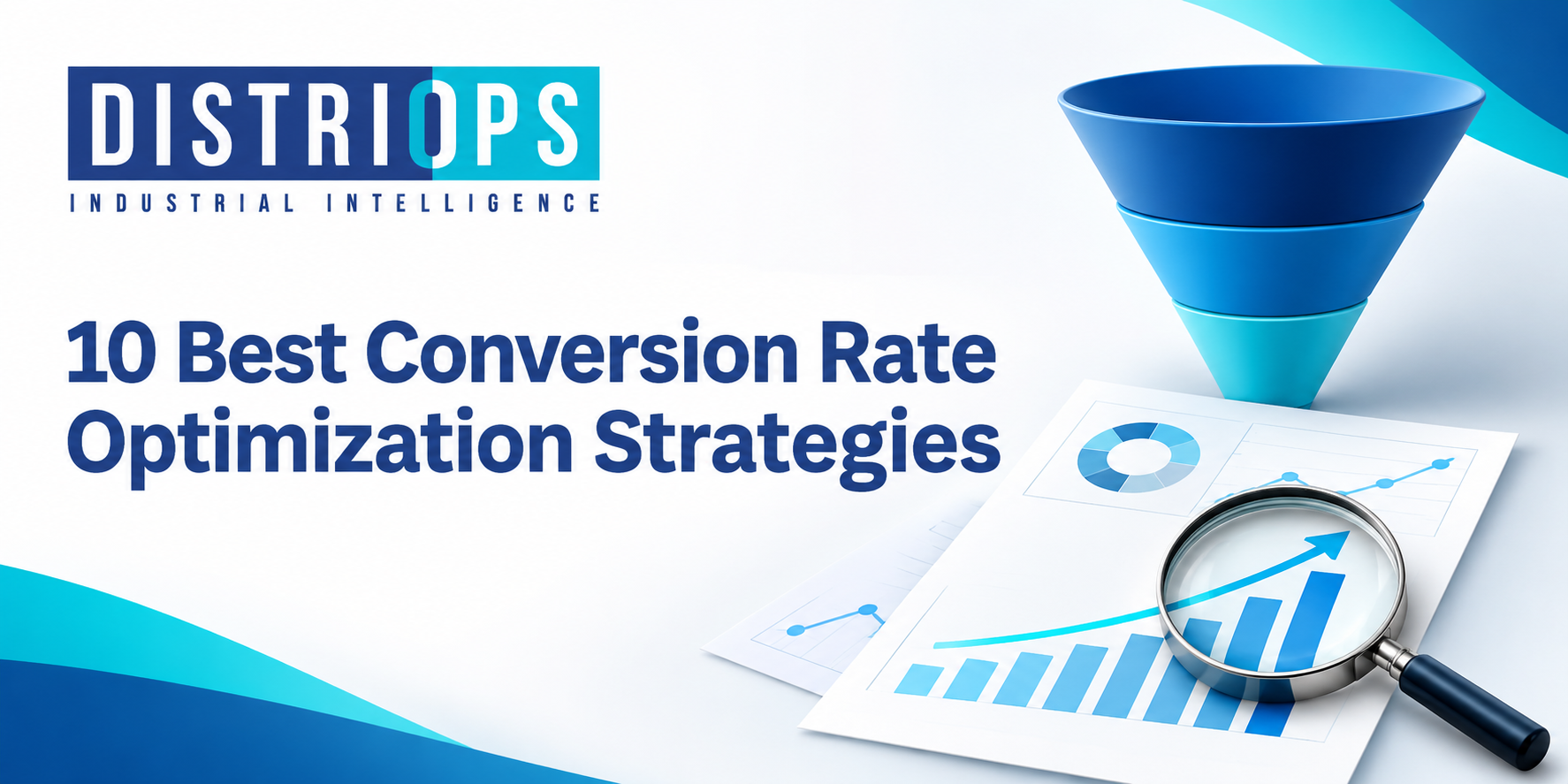
Improve digital experiences to turn more visitors into customers and maximize conversion performance. These 10 conversion rate optimization strategies help businesses reduce friction, increase engagement, and drive measurable growth.
10 Best Conversion Rate Optimization Strategies

Distriops
ON THIS PAGE
Free Match
Find an RFQ partner for your category
Tell us your product lines and current turnaround time. We’ll match you with vetted partners built for your exact vertical.
2,500+
Vetted partners
27
Verticals
Increasing conversions from existing website traffic is the fastest lever for driving capital-efficient business growth. While acquiring cold traffic grows increasingly expensive, acquiring customer insights through qualitative and quantitative user research directly multiplies pipeline value.
There is no universally superior tactic across digital marketing environments; effective optimization depends entirely on identifying specific funnel bottlenecks. A structured, data-driven framework ensures marketing investments focus on eliminating proven user friction points rather than implementing unvalidated design preferences.
How to Choose the Right CRO Strategy
Selecting an optimization framework requires diagnosing structural drop-offs throughout your user journey before launching experiments. Applying structured outsourced conversion optimization services for startups allows growing teams to identify funnel friction rapidly without diverting internal product engineering resources.
Analyzing quantitative conversion funnels reveals exact pages and workflow steps where prospective customers abandon sessions. Comparing traffic volumes, engagement depth, and completion rates across devices uncovers high-impact diagnostic targets.
Pairing quantitative funnel metrics with qualitative behavioral analytics exposes the root causes of user friction. Combining heatmaps, session recordings, click tracking, customer feedback surveys, and form analytics highlights exact user frustration points.
Identify Where Users Drop Off
Analyzing quantitative conversion funnels reveals exact pages and workflow steps where prospective customers abandon sessions. Comparing traffic volumes, engagement depth, and completion rates across devices uncovers high-impact diagnostic targets.
Use Data to Find the Cause of Friction
Pairing quantitative funnel metrics with qualitative behavioral analytics exposes the root causes of user friction. Combining heatmaps, session recordings, click tracking, customer feedback surveys, and form analytics highlights exact user frustration points.
223%
is the average return on investment generated by enterprise organizations using structured CRO methodologies and testing tools. – Wingify
22%
of global enterprise organizations report being genuinely satisfied with their current digital conversion rates. – HubSpot
$23.64 Billion
is the projected global market size for conversion rate optimization software by 2032, expanding at a 12.2% CAGR. – Verified Market Research
10 Best Conversion Rate Optimization Strategies
Deploying systematic experimentation frameworks enables businesses to maximize lifetime customer value and lower client acquisition costs. Modern digital brands utilize specialized growth conversion optimization services for startups to build repeatable testing velocity across core acquisition channels.
Establishing precise conversion targets begins by defining primary business success metrics, such as lead form completions, demo bookings, or checkout steps. Quantitative baseline metrics provide the statistical groundwork necessary to measure performance lifts accurately.
Formulating testable hypotheses connects user behavioral data directly with proposed design interventions. A structured hypothesis defines the target user segment, the specific operational change, and the expected metric lift based on research findings.
Aligning landing page copy and visual layout with originating traffic sources eliminates immediate cognitive dissonance. High-converting landing pages reinforce specific search intent, confirm value propositions instantly, and remove competing navigation links.
Streamlining visual elements focuses user attention directly on primary call-to-action triggers. Deploying specialized outsourced conversion optimization services for coaches ensures content-driven service platforms maintain clear visual pathways to booking calendars.
Optimizing call-to-action (CTA) elements requires refining button messaging, visual contrast, screen placement, and contextual positioning. Generic action verbs like “Submit” generate higher friction than value-focused phrases like “Get Your Growth Audit”.
Testing CTA placement across desktop and mobile viewports ensures core conversion triggers remain accessible throughout the browsing experience. Isolating and testing single variables prevents confounding data during experimentation.
Excessive form fields create immediate conversion drag across lead generation and checkout workflows. Removing optional inputs, utilizing smart field validation, and enabling autofill features significantly accelerates completion rates.
Breaking complex, multi-step intake procedures into progressive visual stages reduces perceived task effort. Deploying specialized outsourced conversion optimization services for startups allows service firms to streamline client intake questionnaires without losing qualification depth.
High-converting copy addresses primary customer objections, risk factors, and functional pain points directly within main content sections. Emphasizing tangible business outcomes rather than simple product features increases message resonance.
Structuring page copy with clear subheadings, bulleted lists, and bold emphasis allows scanning users to absorb value propositions quickly. Iteratively testing headlines and subheadings exposes the messaging angles that drive maximum response rates.
Deploying visual behavioral tracking tools uncovers hidden usability issues across critical user paths. Analyzing heatmaps, scroll maps, and click tracking reveals whether key value propositions receive adequate visual attention.
Session recordings reveal rage clicks, broken JavaScript elements, and confusing UI layouts that cause unexpected drop-offs. Connecting qualitative behavioral findings to test hypotheses ensures CRO roadmaps focus on resolving genuine user obstacles.
Prominently displaying verified customer testimonials, client logos, industry certifications, and detailed case studies builds immediate brand credibility. Third-party verification indicators reduce perceived risk for first-time website visitors.
Positioning trust signals near high-friction decision points—such as payment forms or pricing tables—directly mitigates user hesitation. Incorporating explicit money-back guarantees, clear data privacy commitments, and secure payment badges further increases conversion confidence.
Removing unnecessary navigational choices and intrusive pop-up elements prevents user distraction along primary conversion paths. Streamlining checkout or sign-up steps directs user focus squarely on completing the primary transaction.
Aligning each step of the conversion funnel with explicit user expectations builds momentum toward goal completion. High-growth enterprise teams frequently retain dedicated conversion rate optimization services to audit funnel architectures and eliminate structural drag.
Slow page rendering times directly degrade user engagement and increase bounce rates across all device categories. Optimizing image assets, leveraging browser caching, and minimizing render-blocking scripts accelerates page load speeds significantly.
Ensuring mobile layouts feature touch-friendly targets, simplified navigation menus, and streamlined form inputs protects mobile conversion performance. Prioritizing performance engineering on high-traffic landing pages maximizes revenue potential.
Executing structured A/B and multivariate tests provides statistical confirmation before deploying site-wide design changes. Establishing baseline controls ensures performance lifts reflect genuine user behavior rather than seasonal anomalies.
Maintaining tests until achieving statistical significance prevents premature deployment conclusions. Documenting experiment findings creates an internal knowledge base that informs future product design and marketing campaigns.
1. Set Clear CRO Goals and Testable Hypotheses
Establishing precise conversion targets begins by defining primary business success metrics, such as lead form completions, demo bookings, or checkout steps. Quantitative baseline metrics provide the statistical groundwork necessary to measure performance lifts accurately.
Formulating testable hypotheses connects user behavioral data directly with proposed design interventions. A structured hypothesis defines the target user segment, the specific operational change, and the expected metric lift based on research findings.
2. Optimize Landing Pages Around User Intent
Aligning landing page copy and visual layout with originating traffic sources eliminates immediate cognitive dissonance. High-converting landing pages reinforce specific search intent, confirm value propositions instantly, and remove competing navigation links.
Streamlining visual elements focuses user attention directly on primary call-to-action triggers. Deploying specialized outsourced conversion optimization services for coaches ensures content-driven service platforms maintain clear visual pathways to booking calendars.
3. Improve Your Calls to Action
Optimizing call-to-action (CTA) elements requires refining button messaging, visual contrast, screen placement, and contextual positioning. Generic action verbs like “Submit” generate higher friction than value-focused phrases like “Get Your Growth Audit”.
Testing CTA placement across desktop and mobile viewports ensures core conversion triggers remain accessible throughout the browsing experience. Isolating and testing single variables prevents confounding data during experimentation.
4. Reduce Friction in Forms and Signup Processes
Excessive form fields create immediate conversion drag across lead generation and checkout workflows. Removing optional inputs, utilizing smart field validation, and enabling autofill features significantly accelerates completion rates.
Breaking complex, multi-step intake procedures into progressive visual stages reduces perceived task effort. Deploying specialized outsourced conversion optimization services for startups allows service firms to streamline client intake questionnaires without losing qualification depth.
5. Rewrite Copy to Address User Pain Points and Objections
High-converting copy addresses primary customer objections, risk factors, and functional pain points directly within main content sections. Emphasizing tangible business outcomes rather than simple product features increases message resonance.
Structuring page copy with clear subheadings, bulleted lists, and bold emphasis allows scanning users to absorb value propositions quickly. Iteratively testing headlines and subheadings exposes the messaging angles that drive maximum response rates.
6. Use Behavioral Analytics to Find Conversion Friction
Deploying visual behavioral tracking tools uncovers hidden usability issues across critical user paths. Analyzing heatmaps, scroll maps, and click tracking reveals whether key value propositions receive adequate visual attention.
Session recordings reveal rage clicks, broken JavaScript elements, and confusing UI layouts that cause unexpected drop-offs. Connecting qualitative behavioral findings to test hypotheses ensures CRO roadmaps focus on resolving genuine user obstacles.
7. Build Trust With Social Proof and Risk Reducers
Prominently displaying verified customer testimonials, client logos, industry certifications, and detailed case studies builds immediate brand credibility. Third-party verification indicators reduce perceived risk for first-time website visitors.
Positioning trust signals near high-friction decision points—such as payment forms or pricing tables—directly mitigates user hesitation. Incorporating explicit money-back guarantees, clear data privacy commitments, and secure payment badges further increases conversion confidence.
8. Simplify the Conversion Funnel
Removing unnecessary navigational choices and intrusive pop-up elements prevents user distraction along primary conversion paths. Streamlining checkout or sign-up steps directs user focus squarely on completing the primary transaction.
Aligning each step of the conversion funnel with explicit user expectations builds momentum toward goal completion. High-growth enterprise teams frequently retain dedicated conversion rate optimization services to audit funnel architectures and eliminate structural drag.
9. Improve Page Speed and Mobile Experience
Slow page rendering times directly degrade user engagement and increase bounce rates across all device categories. Optimizing image assets, leveraging browser caching, and minimizing render-blocking scripts accelerates page load speeds significantly.
Ensuring mobile layouts feature touch-friendly targets, simplified navigation menus, and streamlined form inputs protects mobile conversion performance. Prioritizing performance engineering on high-traffic landing pages maximizes revenue potential.
10. Run Continuous A/B Tests and Iterate
Executing structured A/B and multivariate tests provides statistical confirmation before deploying site-wide design changes. Establishing baseline controls ensures performance lifts reflect genuine user behavior rather than seasonal anomalies.
Maintaining tests until achieving statistical significance prevents premature deployment conclusions. Documenting experiment findings creates an internal knowledge base that informs future product design and marketing campaigns.
Scaling digital revenue requires systematically eliminating user friction points through structured experimentation. Investing in specialized ROI-driven conversion optimization services for agencies transforms existing traffic into predictable pipeline velocity without expanding acquisition budgets.
Chief Growth Officer, Enterprise Scale Partners
How to Prioritize CRO Opportunities
Selecting which page elements to optimize first determines the speed and financial return of your experimentation program. Utilizing a structured prioritization framework prevents teams from wasting resources on low-impact website tweaks.
Applying scoring models, such as the ICE (Impact, Confidence, Effort) or PIE (Potential, Importance, Ease) frameworks, ranks potential tests objectively. Evaluating expected conversion lift against engineering complexity ensures high-return hypotheses receive top priority.
Prioritizing pages with high traffic volume and elevated drop-off rates yields faster statistical significance and larger absolute revenue gains. Optimizing a high-friction checkout step generates higher financial returns than testing elements on low-traffic secondary pages.
Focusing experimentation cycles on core value propositions, pricing structures, and primary lead forms maximizes learning velocity. Testing high-value strategic changes delivers actionable business insights faster than micro-testing button colors or minor padding adjustments.
Score Opportunities by Impact, Effort, and Confidence
Applying scoring models, such as the ICE (Impact, Confidence, Effort) or PIE (Potential, Importance, Ease) frameworks, ranks potential tests objectively. Evaluating expected conversion lift against engineering complexity ensures high-return hypotheses receive top priority.
Start With High-Traffic, High-Friction Pages
Prioritizing pages with high traffic volume and elevated drop-off rates yields faster statistical significance and larger absolute revenue gains. Optimizing a high-friction checkout step generates higher financial returns than testing elements on low-traffic secondary pages.
Test the Highest-Value Hypotheses First
Focusing experimentation cycles on core value propositions, pricing structures, and primary lead forms maximizes learning velocity. Testing high-value strategic changes delivers actionable business insights faster than micro-testing button colors or minor padding adjustments.
Accelerate Your Revenue Engine
An experienced experimentation agency can audit your sales funnels, isolate user friction points, construct validated testing hypotheses, and run statistical A/B tests to maximize your acquisition ROI.
CRO Mistakes to Avoid
Executing conversion rate optimization without strict methodological governance often leads teams to adopt flawed testing practices that distort data integrity. Recognizing and avoiding these common implementation errors protects testing velocity, prevents false conclusions, and ensures experimentation budgets generate measurable bottom-line growth.
- Copying Competitors Without Testing: Blindly adopting competitor design trends assumes their layout is optimized, ignoring unique audience behaviors and business models.
- Making Too Many Changes at Once: Modifying multiple visual variables simultaneously within a single test variation makes it impossible to isolate which specific change drove the performance lift.
- Optimizing for Clicks Instead of Conversions: Focusing solely on micro-conversions, such as button clicks, without tracking downstream lead quality or revenue generation skew test results.
- Ending Tests Too Early: Stopping experiments before reaching statistical confidence or adequate sample sizes leads to false positives caused by temporary traffic spikes.
- Relying on Opinions Instead of User Data: Allowing internal HIPPO (Highest Paid Person’s Opinion) preferences to override empirical user analytics compromises experiment integrity.
Conclusion
Executing a structured conversion rate optimization strategy transforms existing traffic into a reliable source of sustainable pipeline growth. By combining quantitative analytics with qualitative behavioral tracking, marketing leaders can eliminate funnel friction systematically and maximize acquisition returns.
Success requires moving away from ad-hoc site tweaks toward a disciplined, hypothesis-driven experimentation culture. Prioritizing high-impact funnel bottlenecks, testing major value propositions, and maintaining rigorous statistical standards ensures continuous revenue growth over time.
Sources & References
- Wingify: Conversion Rate Optimization Statistics & Industry Benchmarks 2026
- Verified Market Research: Conversion Rate Optimization Software Market Size & Forecast 2026
- Wizard of Ads: Factors That Affect Your Conversion Rate [+ CRO Statistics] 2023
Providers You Might Be Interested In
Vetted partners matched to the topics covered in this article.
QF
Verified
QuoteFlow Solutions
RFQ & Pricing Support
Dedicated quoting teams for electrical, MRO, and industrial automation distributors.
★
4.9 (128 reviews)
12 yrs in business
AR
Verified
Apex RFQ Partners
RQuote Management BPO
24-hour SLA-backed quote turnaround with full CPQ and ERP integration support.
★
4.8 (94 reviews)
8 yrs in business
PL
Verified
PriceLogic Outsourcing
Pricing & Order Support
Specialists in contract pricing accuracy and tiered-discount management for distributors.
★
4.7 (78 reviews)
15 yrs in business



About DistriOps
Built for Industrial Operations & Execution
DistriOps is designed to help industrial distributors, manufacturers, and operations-heavy businesses connect with trusted operational partners faster.
What DistriOps Helps Businesses Do
- Find verified outsourcing and operational service providers
- Simplify partner discovery across industrial operations
- Reduce operational bottlenecks and manual workload
- Scale procurement, supply chain, and back-office support faster
- Access specialized execution support teams
- Improve operational efficiency across workflows
- Support high-volume operational environments
- Connect with partners experienced in industrial distribution and manufacturing
- Streamline vendor evaluation and operational collaboration
- Discover operational expertise across multiple business functions
Why DistriOps?
 Built specifically for industrial distribution & manufacturing Access to 2,500+ operational partners Focused on execution-heavy business operations Trusted network of vetted service providers Supports procurement, product data, customer support, finance & supply chain operations Faster partner discovery & operational scaling Designed for modern industrial workflow challenges